Robotic 808 drum machine

Introducing fallibility with robotic precision

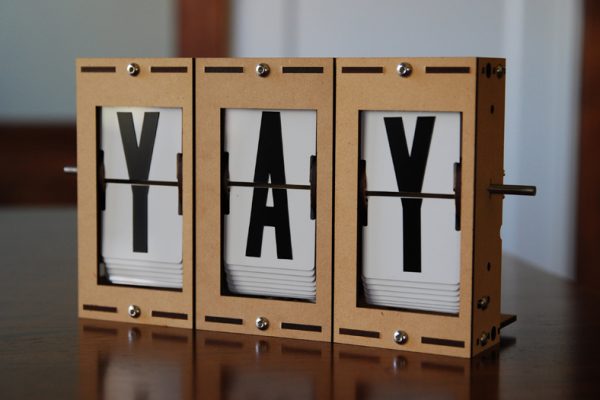
Inspired by the sounds of the infamous TR-808 drum machine, this robotic instrument by Moritz Simon Geist is unusual in that it explores the concept of “errors” in music.

“A drum beaten by a mechanic robot arm can never be as predictable as a computer generated sound. Consequently, the mechanic character of the installation introduces fallibility into the performance.”

The assortment of percussion instruments are struck using motors and solenoids connected to an Arduino board. This combination of analog parts and robotic controllers is the result of an extensive experimentation process designed to recreate the iconic 808 soundscape.

Discover more about how this was achieved along with other robotic instruments at the project homepage on Sonic Robots.

MR-808 via BoingBoing

3D printable folding Arduino lab

A versatile case to keep your next Arduino project protected and organized.

This folding Arduino case was designed by Jason Welsh. It holds an Arduino and a breadboard, and it has two drawers for all the parts you need for your project. When you finish your project, just fold it up and use it as a project box to protect your hard work. Last but not least, the box is fully 3D printable, with the small exception of the hardware.

The files are available on Thingiverse so you can make your own.

Via Makerbot

Hummingbird is a ‘pre-Arduino’ for kids

Making it even easier to get into electronics

We all know and love Arduino, and what it has done for the rapidly growing world of DIY electronics. Yet the complexities of Arduino can be a bit much for young makers, and education enthusiast Tom Lauwers just may have the answer to harness that creativity while it is still fresh.

Heralded as a kind of “pre-Arduino”, the Hummingbird kit from Birdbrain consists of a custom controller that connects to a range of motors, sensors and lights that allow kids to build their own functional robots and more.

“…the Hummingbird controller is designed for kids who have never touched electronics or programming before.”

It’s really easy to get started making fully functional electronic devices, but don’t take our word for it. Click through to the source where Tom talks it all through in a neat clip featuring an animatronic cardboard dragon made by some 10 year old kids. Now that’s seriously fun.

Hummingbird via Engadget

An open source computer controlled Jacquard loom

Introducing the Osloom.

Osloom (Open Source Loom) is an ongoing project to make an open source, computer controlled Jacquard loom.

The alpha prototype has a 64-thread count and is on an aluminum extrusion frame. The actuators we are using are muscle wire. They contract when electricity is run thru it. The loom itself is a little under 2 feet wide by 4 feet long by about 7 feet tall. The loom is controlled by software running on a laptop via an Arduino using a bit-shift register circuit . . . It works off bitmap images.

Speaking as someone who has seen computer-controlled loom in operation, they are astoundingly complex machines. Making one is an impressive undertaking, to say the least. Despite the fact that they predate 3D printers by a considerable margin, I suspect it is considerably more difficult to make a loom like this than a 3D printer.

Via MAKE

‘Making Things’ opens this Saturday in NYC at experimental retail shop STORY

And features lots of Ponoko-made products!

STORY is a different kind of retail shop that aims to support both commerce and the community. The 2000 square foot space in Manhattan’s Chelsea neighborhood rotates merchandise based on a monthly theme and hosts various events that tie in.

STORY’s newest theme ‘Making Things’ opens this Saturday, October 6 at 11am and runs through October 28.

The new retail assortment will relate to the concept of Making Things, from products with a literal interpretation such as DIY kits to items with a more abstract relationship to the theme like ‘making memories’ or ‘making time’.

We were delighted to have five Ponokoans invited to sell their designs at STORY this month:

(more…)

Laser-cut mechanical Donkey Kong

Complete with original NES controller!

This is amazing: Martin Raynsford combined a couple servos, switches, and ball bearings with an Arduino and a lot of laser-cutting to make a functioning electro-mechanical replica of the beloved old Donkey Kong game. Not satisfied with this awesome (and well documented) build, Martin already has plans to scrap version 1 and rebuild the game to bring in even more of the original gameplay. Genius!

Center pivot pen plotter

Unique CNC drawing machine: Is this the shape of things to come?

There is no shortage of DIY CNC and 3D printing devices, and although some do stand out from the crowd, they all tend to follow a geometry that is becoming quite familiar. Setting out to change this paradigm, Canadian techno-sculptor David Bynoe conceived of a CNC plotter that is focused around polar coordinates.

The Center Pivot Pen Plotter has only one arm that spins on a base, and moves in and out from a central point.

“It gives you a very large drawing surface with a minimum of moving parts compared to a standard x,y Cartesian plotter.”

Drawing inspiration from the notable dual polar Eggbot and Polargraph examples, David has gone one step further in simplifying the mechanism by using only a single polar coordinate system. This creates special challenges, but the code that drives the Arduino-equipped device has been written to compensate for geometric distortions. As the video after the break shows, he’s done remarkably well…

“The goal was to get it working and then worry about making it pretty, which I will get to eventually.”

(more…)

Laser-cut force feedback controller for Angry Birds

Simulating a slingshot with an Arduino, motorised fader, and MaxMSP

{sound + design} released a beautifully executed and beautifully documented hack this month.

Super Angry Birds is a force feedback USB controller for Angry Birds that simulates the feeling of a slingshot. All the controls found in the game are available in this device. You can control the pull, the angle, and of course trigger the special power of the bird.

Underneath the slick design is a serious piece of hardware and software engineering work. Very cool.

Type A Machines introduces big new 3D printer

Meet the new kid on the block. Hope you’re not intimidated by size…

Thinking big is kind of healthy, in the world of DIY creativity. And with this new offering from SF based Type A Machines, 3D printing just received a hefty size boost.

Keeping things on track for the budget conscious consumer, the Series 1 3D printer can be purchased for $1200 and will arrive fully assembled. That’s pretty good value for a device that is capable of speedy printing at high resolutions (0.3mm at high speed) and detail printing down to 50 microns. It’s also said to be super quiet, and the RepRap Arduino MEGA Pololu Shield (RAMPS) based system will happily respond to all your favourite software combinations to crunch your model data.

If you’re still not impressed, stop for a moment and think over what you can make with a 9 x 9 x 9 inch build volume. That’s 230 x 230 x 230mm! A whole 12.1 litres of 3D printed joy.

Perhaps it’s time to get a bigger desk…

Type A Machines via Hack a Day

Ben Heck’s portable 3D printer

It’s alive! The Briefcase Printer revisited and heading to Kickstarter

It’s hard to go far in the DIY gadget world without hearing about the exploits of modder extraordinaire, Ben Heck. Famous for squeezing almost every electronic device imaginable into a briefcase, his latest efforts revisit a project to build a fully operational Briefcase 3D printer.

An earlier attempt did have its successes, but Ben always knew he could go further with this particular project. And now he has.

The Briefcase Printer folds out from a neat 4.2 x 18 x 14 inch frame, and boasts a 200mm2 build platform. It’s able to run autonomously by reading files off an SD card, or for more control and a smoother user experience, the onboard Arduino 2580 Mega can be connected directly to a computer.

It’s all explained with Ben’s trademark enthusiastic delivery in a comprehensive video after the break.   (more…)