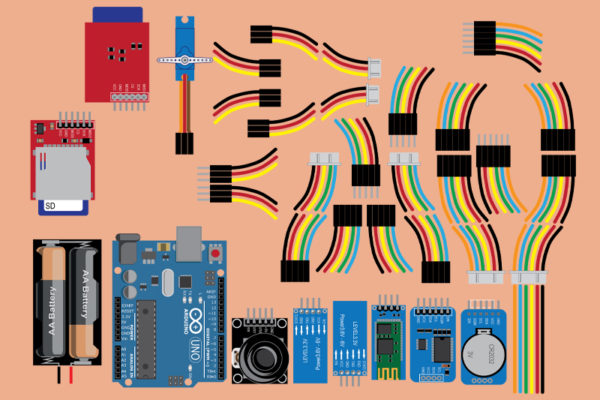
This litter box was made by Greg Leisure with the help of an Arduino. It is quite possibly the most elaborate cat litter box ever built. Even calling it a litter box seems disrespectful. It’s more like a litter house. Or a litter condo. It has it all, all the bells and whistles a cat or cat owner could want. Lights with motion sensors? Check. Both sound and smell dampeners? Check. Automatically-triggered fans? Naturally. Automatic Lysol dispensers? Of course. (more…)
A simple, open source camera you can make at home.
Photographer Product Designer Coralie Gourguechon made the Craft Camera as a way of countering the “planned obsolescence and complexity of electronic products.” All of the components are open source, and the design has a Creative Commons license.
The major components, in addition to an Arduino UNO, are a lithium battery pack, a Snootlab SD card Arduino shield, and a JPEG color camera TTL interface. The design for the case can be printed onto cardboard, cut out with a utility knife, and glued together. More detailed information is available on the project’s open source page, but the code and detailed plans are, unfortunately, not yet available. The site says they will be “released soon,” so be sure to check back later. (more…)
If you want to see if you truly understand how a mechanical system works, try making it out of cardboard. Artist Niklas Roy led the construction of a series of cardboard computers, including this plotter, as part of an electronic media class at the School of Art and Design, Offenbach. Watch the video above to see the remarkable sophistication of this mechanical computer. (more…)
Arduino, 3D printing, and clever engineering result in an affordable prosthesis.
Easton LaChappelle has made a series of continuously improving robotic hands. The first, which he made at age 14, won 3rd place at the Colorado state science fair, and the second, which we previously covered, won 2nd place at the Intel International Science and Engineering Fair, the top science fair in the USA. At the Colorado fair he met a little girl who wore an $80,000 prosthetic arm, and he was convinced he could do better. (more…)
Matthew Borgatti of HAR.MS made this slightly disconcerting yet undeniably fascinating prototype of an air-powered robotic tentacle. The tentacle itself is made of silicone, and an Arudino and three solenoid valves control the flow of air that make the tentacle bend and twist. Borgatti also made a simple visual user interface with Processing to operate it.
“Soft robotics” like this have several potential advantages over the more traditional “hard” systems. A soft arm is more gentle with far fewer moving parts, and is, in some ways, more resistant to damage that a typical robotic arm. (more…)
Put one of those old cellphones lying around to good use.
Most people have at least one or two old cellphones sitting in a drawer somewhere. Now you can use one for your next Arduino project. Alex of insideGadgets has kindly posted a detailed tutorial showing how to hack and old Nokia 6110 (or any derivative) to send text messages from an Arduino. Even if you don’t have one of these sitting around, old technology (aka project materials) can be bought at absurdly low prices.
An open source, 3D printable humanoid robot is in development and available for download from Thingiverse. Right now only the arms can be downloaded, but the head and torso are promised as soon as the design has been refined.
InMoov is a project by Gael Langevin, a French sculptor (Thingiverse user hairygael). Langevin has been working on InMoov since early 2012 and has gone through numerous design iterations and discarded 3D prints since that time. The progress is nothing short of outstanding. As you can see in the video below, this is a fully articulated humanoid robot, a rarity outside the research labs of corporations and universities. (more…)
Arduino audio processor packed in to a bottle full of beats
Everyday sounds become dynamic, ever-changing musical tracks with this student concept by Jun Fujiwara from Tama Art University in Japan.
The Re: Sound Bottle hides some complex electronics behind that sleek outer shell, in order to process and pump out some rockin’ beats.
The bottle begins recording as soon as you pop the cork, and it stores these audio samples to then remix them on demand in a cool rhythmic track. Here’s how Jun describes this mini DJ-in-a-jar:
“I felt something missing in the habitual use of music reproduction media, so I thought to create an interactive music medium that changes. By using everyday voices as sources of music, the sounds that are heard all the time every day carry infinite possibilities and help us reaffirm the enjoyment of music. I hope people can experience their own music.”
Click through to see a perky clip of the Re: Sound Bottle doing it’s thing, and you’ll understand why it was a deserving prize winner at the Mitsubishi Chemical Junior Designer Awards in 2012.
Nick Thatcher built this self-balancing unicycle using an Arduino UNO, a IMU (gyroscope) from Sparkfun, a 24v 350w geared motor, a wheelbarrow wheel, and a handful of other basic parts.
The IMU senses when the unicycle tilts too far forward or backward, the Arduino does some calculations, and then the motor compensates. The rider still has to put a little effort into maintaining balance (and not falling sideways), but it wouldn’t be much fun if the Arduino did all the work.
Learn about microcontrollers without using breadboards
The Arduino system has done much to help introduce makers both young and old to the world of DIY electronics. Much lauded for its remarkable versatility and ease of use, all it takes are a few components and you’re on your way to new and exciting programming pleasures.
For those just starting out who find breadboards and wires a little daunting, the Arduino Esplora is a hand-held unit already fitted with a number of sensors, controllers and connections all ready to go right out of the box.
“…a ready-to-use, easy-to-hold controller that lets you explore the infinite possibilities you have in the world of Arduino, without having to deal with breadboards or soldering. Shaped like a game controller, it’s designed to be used out of the box without extra parts since it comes with many sensors and actuators already on it.”
Built around the same core as the popular Arduino Leonardo, the Esplora boasts an accelerometer, microphone, analog joystick, button array, light sensor, temperature sensor, linear potentiometer and audio buzzer. Although it lacks the facility to connect extra components like we are used to seeing with Arduino shields, there are two TinkerKit inputs and outputs that will enable further expansion.
Additional modules such as LCD displays are in the works, and knowing the Arduino community, it won’t be long before there is a whole host of enhancements available. Eager beavers can get their hands on an Arduino Esplora right now for under €42.