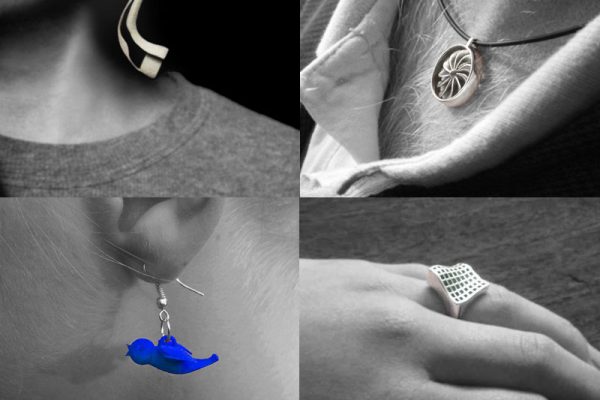
3D printed math art by Asher Nahmias (aka Dizingof)

Incredible procedurally generated designs

3D printed steel gyroid vase by Dizingof

If you’re a regular Personal Factory user, you may have seen the wonderful 3D models available for sale in Dizingof’s showroom.

Dizingof specializes in math art, which generally refers to works that have been procedurally generated with a focus on aesthetic qualities. That aesthetic quality is readily apparent in 3D models like these: (more…)

Related posts:

Finishing hobbyist 3D prints

Smooth as a.. thing that is very smooth

3D printed pig from MakerBot TV S02E09

Objects that come out of most hobbyist 3D printers look a bit rough. The printing process creates ridges and swirls that, in my opinion, look nice and homemade… But to others that look can be an eyesore.

Luckily, ABS plastic is very receptive to post-processing. As I tell folks whenever I run a 3D printing demo: you can sand it, drill it, paint it, you name it.

The team at MakerBot TV recently put together an episode showing some of these finishing techniques, including the use of modeling epoxy: (more…)

Related posts:

Parametric lattice models made with Modelbuilder

Generating great geometry

Lattice prints by Marius Watz

Marius Watz, the original artist-in-residence at MakerBot, recently published his Modelbuilder library to github and 3D printed some lattice structures that he’s generated with it.

Modelbuilder is a library for artist programming tool Processing that aims to streamline the creation of geometric 3D models for printing. It comes with a few examples, like a script that creates these random badge-like shapes: (more…)

Related posts:

3D printed balloon shapes (with video!)

Novel approach to producing inflated shapes

3D printed balloon process, showing optimized and unoptimized figures

Making balloon animals (and balloon anythings) is about to become much cooler. That’s because a collaboration between ETH Zurich and Disney Research Zurich has produced a new approach to making inflatable shapes with 3D printed molds.

The traditional method of creating rubber balloons using a sculpted mold does not lend itself to complex shapes. But the method described by Bernd Bickel and crew instead uses models of uninflated shapes that can be computer-simulated to reach a target inflated shape.

Basically, by figuring out the “at rest” state of the balloon and 3D printing that as a mold, the inflated version can be a perfect shape instead of a blown-out, distorted version that would come from simply inflating a scaled-down model.

Have a look at this video comparison to see the difference between optimized and unoptimized shapes as they are inflated: (more…)

Related posts:

3D printing with polycarbonate

Durable plastic for durable prints

Polycarbonate T-Slot, by ProtoParadigm

Ever needed to 3D print something in a strong, clear material? It’s always exciting to see hobbyist printers being used with non-ABS/PLA materials, and polycarbonate is no exception.

From what I can tell, RichRap was the first person to use polycarbonate in a hobbyist device back in mid-2011. Those efforts were followed-up on by Luke and Alex of ProtoParadigm, who wrote a thorough blog post on the subject.

The main gist is that polycarbonate (also known as Lexan, or that-stuff-the-white-MacBook-is-made-of) is very strong, and can have great transparency. The catch is that it has to be kept or made very dry before extrusion: filament affected by humidity produces a milky sheen and causes bubbles in prints.

Here’s a video of polycarbonate printing in action, from ProtoParadigm: (more…)

Related posts:

Open source resin 3D printers in development

Hobbyists work on affordable resin printing tech

Christopher Jansen's DLP-based resin 3D printer

After posting about Junior Veloso’s resin 3D printer last week (and its higher-than-expected price), commenters arthur and Adam B. pointed to a couple of cost-sensitive open source projects in the works: Lemon Curry and an unnamed printer by Christopher Jansen.

Both are still in the experimental stage, but expect to deliver low-cost, open source solutions that any person should be able to put together and get running. In the case of Jansen’s printer, his running tally of costs is under $200, including a used DLP projector from eBay.

Resin cost is also a big factor. An inexpensive printer wouldn’t very useful if it required paying hundreds of dollars per litre of building material, after all. Both projects have referenced Bucktown Polymers as a source for UV-curable resin for the equivalent of about $40/litre. Jansen made this short video of the resin curing under sunlight: (more…)

Related posts:

Fundraising begins for Junior Veloso’s resin-based 3D printer

Long-awaited project aims to raise $300,000

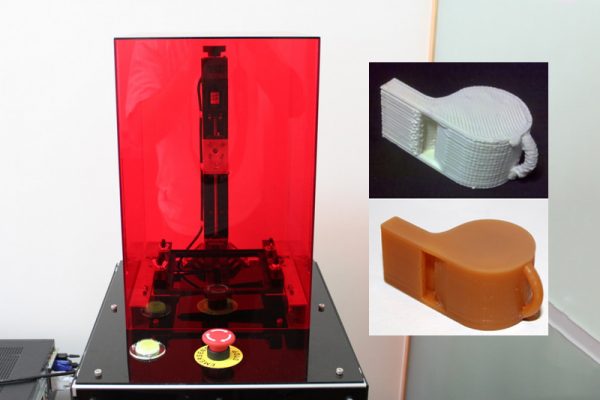
Prototype and whistles

Well, it took a bit longer than the post last month indicated, but Junior Veloso’s awesome-looking resin-based 3D printer is now taking preorders.

Since the project will need a certain minimum amount of interest to be practical, the preorders are being done in the form of an Indiegogo campaign. (Indiegogo is similar to Kickstarter, but with more flexibility in funding and location terms.)

Here’s how the main campaign levels break down:

  • – $599 Basic Kit I
    Software, controller board, schematics/plans
  • – $1,999 Basic Kit II
    Above, plus motors, linear actuators, power supply, building tray, building head
  • – $3,999 Full Kit
    Above, plus DLP projector, 1kg of resin, assembly tools

It’ll be interesting to see how the hobbyist community embraces the project. Before pricing was announced, the project had been described as “very affordable”, which means that the $4000 complete kit price may come with some sticker shock for folks with smaller budgets.

Also, the project will only be funded if it reaches its $300,000 goal by May 31st. Things are looking good though – after two days there are already 11 people signed up for the full kit.

For more information, including the other reward levels, check out the campaign page here: http://www.indiegogo.com/veloso3dprinter

And if you want the full details, a separate FAQ site detailing the hardware/software/material has also been launched here: http://www.wix.com/3dprinterfaq/veloso3d#!kit|mainPage


Derek Quenneville is a 3D printing evangelist who posts weekly on the Ponoko blog. Follow him on Twitter @techknight.

Related posts:

Tinkercad chess design contest

Still a few days left to enter your design

Tinkercad chess design contest

Tinkercad and MakerBot have a two-week chess design contest going on right now. The idea is to redesign the six standard chess pieces (king, queen, bishop, knight, rook, pawn) into brand new forms. The new designs must conform to a size restriction, print well on a hobbyist device, and have a bit of “wow!” factor.

The contest is nearly over (it ends on April 1st at midnight), so I figured I’d take a look at what’s been uploaded to Thingiverse under the chess and Tinkercad tags so far.

These are my three favourite designs based on printability, legibility, and novelty: (more…)

Related posts:

Custom 3D printed wedding cake toppers

Remember the first time we were 3D printed together?

Wedding cake toppers by Yoni Binstock

Designer Yoni Binstock has started a cool new Etsy business: selling personalized 3D printed wedding cake toppers. We’ve seen some 3D printed cake toppers before, but this is the first time I know of where the figures bear a true resemblance to the bride & groom.

Yoni starts with photographs of a couple from the front and the side, and combines those with outfit and hairstyle descriptions to achieve a pretty decent likeness: (more…)

Related posts:

Matherix 3Dify – an upcoming Kinect 3D scanning tool in development

More Kinect scanning tools in the works

I’ve been having fun doing 3D scans with the Kinect and ReconstructMe for a few weeks now. I was just beginning to wonder what other software might pop up in the future, when someone from Matherix Labs invited me to try 3Dify.

Matherix 3Dify is a new Kinect scanning tool that aims to be a simple, low-cost way to make 3D scans of things. It doesn’t have the GPU-intensive real-time model capture of ReconstructMe, but it has a GUI, which might make it a good choice for the less technically-inclined.

The developers have put together a video showing how the process works: (more…)

Related posts: