Home Browse&Buy Make&Sell Mingle&Share

Front and Center: Designed Conversation at ICFF (Part3)

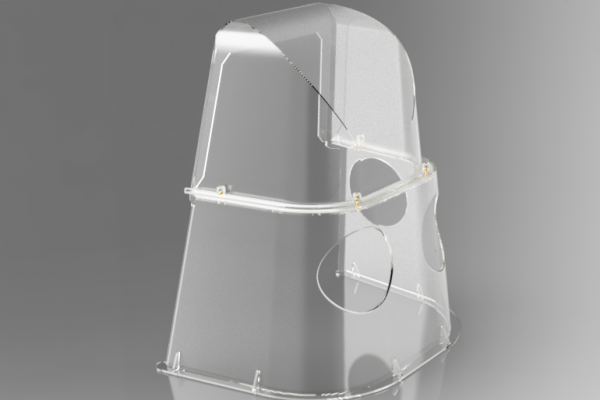
!Update to Part 2: It seems like the “Shelter Screen” was carried on into the final rounds for ICFF. See below.

icff13

As SCAD students of the Designed Conversation course created different bedding solutions for the clients of Growing Hope of Union Mission, one of the most challenging problems was a structure that actually provided shelter for the homeless living on the street.

icff3

This was the prototype presented at the end of April during critique. The canvas slip cover fits over a standard bi-folding lawn chair. Inside the flap was a layer of tulle to represent mosquito netting. There were conversations about how to secure the flap while preventing liquid from dripping inside, how to make the netting functional and convenient, and how to transport the entire structure on one’s back.

icff1 icff2

Above, a student demonstrates the room within the structure and possible issues with not being able to sit up.

icff10

It seems that a more dome-like silhouette was the group’s solution. Unfortunately, I didn’t get a chance to see this prototype, but it looks like the project really came together for ICFF.

icff12

At the end of the critique, I sat down with each groups “documentarians.” Rubi McGrory, a Graduate Fibers student, Alice Meiss and Kathleen Imig, both undergraduates in Fibers, were responsible for documenting the process of their groups, collaborating on the mission statement, and putting together the site for Designed Conversation.

(more…)

What’s In Store: Sasi, Smart and Sexy

As the only girl currently posting, I think it’s important to bring a feminine perspective to Ponoko readers. Women stereotypically aren’t as interested in gadgets, gizmos and toys as men are. But the Sasi vibrator is a tech toy that any self-loving lady can appreciate.

sasi1
Created by Jejoue, this sensual massager is customizable in both function and aesthetic.

“A smooth, rounded head undulates under a thin, silky cover, creating a soft kneading sensation that can be customized by adjusting movement type, speed and vibration. SaSi has two modes. In Natural Mode SaSi does what it is told. It comes pre-programmed with 5 movements, which are easily selected by navigating left or right. In Learn Mode SaSi gradually morphs from one movement to another, trying new sensations. If you dislike a particular movement simply skip to the next one. SaSi will remember this and is less likely to use it again. If SaSi creates a sensation you really like, press the “don’t stop” button. SaSi will remember and use it again next time. Just like a good partner, SaSi gives a different experience every time whilst still incorporating the movements you like best.”

Wow right? A vibrator that works kind of like Pandora and an ipod. I would love to be able to give a review, but unfortunately the $185 toy is out of stock at Babeland, the only distributor in North America.

sasi2

Sasi comes in three color options for the outer ‘facias’ and silicone membrane covers that are phthalate and latex free. Different texture covers will be made available soon, and each massager comes with a charger and charging base. The packaging is classic and discreet too.

sasi3

What’s In Store: Xoddo Let’s Kids Design

What’s In Store will be a weekly topic that covers the products and/or processes of physical or virtual stores. Just yesterday, Xoddo went live to the world. I came across this company via a blurb on Dexigner and decided to check it out. Xoddo is a website that allows customers to design their own stuffed toy based on a single template.

template

Creator Russell Benfanti writes, “As an illustrator and designer I’ve been creating monsters and creatures for years. In fact I’ve had so much fun making monsters for others, that I thought it would be fun to give everyone the opportunity to design their own”.

Russel’s right. It is fun to design your own. And once you do, you can choose to have your Xoddo made, print it out, or share it with others in the gallery. For those overwhelmed by starting from scratch, there are the ‘Starters’ and ‘Randomizer’ features which begin the designing for you. Here are a couple I did on my own.

xoddo1xoddo2

As Duann mentioned in his post on The Four Faces of Mass Customization, Xoddo is of the Adaptive sort. And I think it works really well, especially for a product intended for children. Here are some pictures of actual samples. It looks like all of the fabrics are being digitally printed… a topic I promise to write about soon.

Made from scraps

strata4.jpg

Ryan Frank is a South African born product designer with an obvious passion for sustainable design. He designs mostly furniture; my favourite piece is the Harvey stool. It uses layers of CNC machined waste wood including “a variety of ply, OBS and chipboard”. It’s interesting how this stool challenges the usual furniture aesthetic, although materials like chip board/MDF are often used in furniture they are usually hidden by paint or a veneer. I could understand if people think this stool is ugly however I think the fact that it’s such a cool idea and it’s environmentally friendly makes me see this as a really beautiful piece of furniture.

strata1.jpg

I really like the way the machined layers have been built up to make the 3D form and the way he has used design to add value to the materials.

coathanger_3.jpg

Frank has also designed a coat/belt/accessory hanger made from compressed recycled newspapers that uses a sixties style print beautifully. As I mentioned in a previous post; prints are a great way to add another dimension to a product.

Wanted: Interaction Designer

Ponoko is looking for an interaction designer who is passionate about creating a world-class user experience. As a key player of the team, you are passionate about understanding our users, developing creative solutions to meet their needs, whilst also satisfying business and brand requirements. You will participate in a user-centered design process to ensure that our online product is easy to use and meets the goals of the users and the business. You’ll be responsible for planning project strategies, creating sitemaps, wire frames and navigational structures, performing user testing, and ensuring the final product meets usability best practices. You are an experienced design leader working within project teams and comfortable engaging with a wide range of people.

If you’re interested please email your CV to david@ponoko.com

The Story of Stuff - What it means to be a consumer

main-upper.gif

This may not be something you want to hear right now in the midst of your Christmas shopping and spreading of holiday cheer, but it’s a well-worth story everyone should hear about. This 20-minute video reveals the downward spiral of over-consumption and rampant consumerism that many of us don’t want to know about (kind of like not wanting to know how that juicy steak got on your plate). From extraction, production, distribution, consumption, to disposal, Annie Leonard tracks how our stuff gets made to where it eventually ends up buried in landfills - where 99% of all products manufactured end after only six months of use.

It’s a very harsh look at how we buy, use and discard, usually without much thought to the impact of our actions. Many will agree and some may question her facts. Either way, it’s a compelling story and something we all need to think about and perhaps take steps to stop perpetuating this “linear system in a finite planet”.

So, how does Ponoko fit into this system of pushing goods through as quickly as possible to end up in a landfill? Well, sure we do make “stuff”, but how our stuff is produced and distributed is quite different than those that are mass produced. The chapter on “Production” is a dismal look at reality - that cool toy you bought for your kid most likely contributed to toxic pollution and was made by third world low-paid workers in dire conditions. The chapter on “Distribution” is just as dismal - because she points out all the externalized costs that the final happy customer never sees. To get something so cheap from a super mart, you’ve got to wonder how it’s possible that it comes so cheaply.

These sorts of environmental costs have always been one of the issues Dave and Derek (our co-founders) have been concerned with and an underlying motivator for coming up with the concept of Ponoko. Things like just-in-time manufacturing and distributed creativity (dispersing design and localizing manufacturing) are points of intervention they’ve taken as an alternative to what’s happening now in the materials economy.

See for yourself and watch the Story of Stuff. After you’ve watched the intro, you can click on the chapters underneath to continue watching.

To get the full scoop, go to www.storyofstuff.com. Get on there, get informed, and decide for yourself what you’ll do the next time to go to the mall.

Now on New Servers

After a bit of a hellish week we have finished a move across to a new hosting provider. This was necessary because of the problems we were having with our previous provider. Everything should now be a lot more stable.

For the next 24-36 hours you will see www.ponoko.com redirecting to an IP address. We weren’t able to get a domain name to propagate fast enough. So don’t worry, this is ok.

Website Problems

Our hosting provider is experiencing problems with the hosting center that houses our main servers. This means that our main website will be unstable until they get the problem fixed. We’re really sorry about this, but at this point we can only sit and wait. We will provide an update as we get more information.

UPDATE

Things don’t seem to be getting better. Our provider has now said that they will be abandoning their data center and will be moving the hardware to a new facility. This move is due to start at 10am CST Dec 1 (so in about 8 hours … but where we are in the queue is anyone’s guess). I suspect we will be down for 2 or so hours. I will provide more info as it comes to hand.

UPDATE 2

Our provider has gone silent on us… so there is no new news. The site is working fine at present. I will provide more info as it comes to hand. At this point it’s back to business as usual.

UPDATE 3

You can’t upload files (eps files or images) at present. It is a network issue and we have raised a ticket with our hosting provider. I will provide updates as they come to hand. Sorry.

A quick note to people who have signed up on our website to become beta users …

Hi Everyone, we’ve had a few questions recently about what happens when you sign up for Ponoko at our registration page. Just to clarify, when you sign up you are not provided with automatic access to start using Ponoko, but you are entered into our beta user database. And it’s from this list that we select people to help us out as we move into our live phase.

It’s not easy for us to choose who goes into this beta as we’ve had a lot of people register and we while we’d love to invite everyone at this point we need to really test things so we can provide a level of satisfaction that we’ll keep you happy and excited about being part of Ponoko. If you have not received an invitation so far, do not fret - you will be invited to participate as a ‘public beta tester’ by the end of September!

To get this as good as we can, we are taking it one step at a time. And to date a limited set of ‘private beta testers’ have helped us with various parts of our business – it’s been fantastic, thank you very much. Also thank you for showing so much enthusiasm by sending us your ideas, designs and projects – I promise we will be letting you at it very soon.

Trust me, we can’t wait to let you in and for you to show us what you got.

Digital cool means becoming physical

The Guardian: The missing link between the web and the world

Virtual is great. Online information - visual, audio, artistic, technical, and design for learning, networking or pleasure - it’s all wonderful. But sometimes you just really want to sit down (away from a screen) and just physically HOLD something and look at it. You know what I mean?

Here’s an interesting read by Glyn Moody from the Guardian pointing out the “rise of the analogue as the acme of digital cool”. Moody features two on-demand (2D) printing companies that are the “interface between digital and analogue worlds” that create what people want from the web into physical tactile and most importantly, useful things.

First up is Moo.com’s minicards. Not boring old business cards. These fun customized cards are for social online networkers who may actually and physically meet other people (say, on the street or at a party). It’s a simple idea - nothing new or innovative, but it serves a real purpose in the real world - there has to be a better way of exchanging personal info with someone you meet other than scribbling your number/email/blog on the back of a napkin or receipt. Moo cards use the web and your online info - from your photos on flickr or your avatars to anything else you want on your card - your email address, your blog site and prints it out on nice stylish mini cards.

The second is well-established independent publishing marketplace Lulu.com. Again, here’s a great example of taking digital content and transforming it into the physical - physically printed and bound books that you can buy and hold.

What both these companies do, along with a growing number of others, is printing on-demand personalized/user-generated virtual ideas, designs and information. And we’re seeing it grow with the demand for more customized and personal things - like t-shirts and other items. It goes to show that while digital and virtual are definitely the means, we’re very much still rooted in the physical world.

Close
E-mail It