Inside the Mcor IRIS full color paper-based 3D printer

Printing realistic 3D objects using standard paper.

Mcor’s IRIS printer, previously mentioned on this blog as part of Mcor’s deal with Staples, uses a deceptively simple method for its full-color prints. It “prints” objects by cutting out and gluing together hundreds of layers of paper.

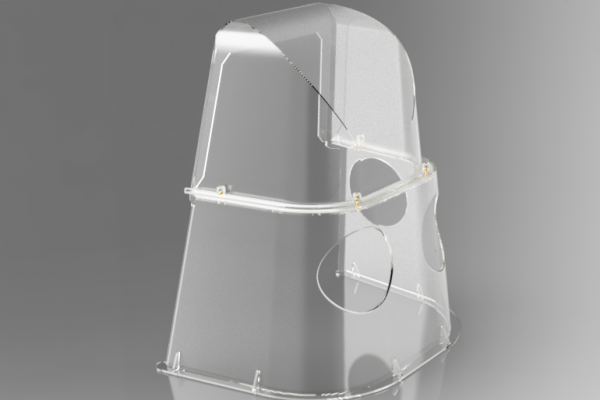
One might imagine all sort of high-tech ways to add color, but Mcor chose a simple, yet highly effective approach. Hidden in a cabinet underneath the IRIS is a standard inkjet printer equipped with ink specially designed to soak through the paper, ensuring thorough color saturation (pictures below). The inkjet also prints a barcoad onto each sheet to make sure they are glued in the right order.
(more…)

Related posts:

Large scale multi-material 3D printer from Objet

Print 14 materials simultaneously with a 1000 x 800 x 500mm build volume.

Objet’s newest offering, the Objet1000, is capable of printing with multiple materials on a large scale without sacrificing print quality. Large-scale 3D printing is slowly becoming more common, but large printers generally print at a low resolution. The Objet1000 is an inkjet-based printer capable of 600dpi on the x- and y-axis and 1600dpi on the z-axis with a 1000 x 800 x 500mm build volume. It can also print up to 14 materials in a single model, chosen from a materials library of 120 possibilities. 
(more…)

Related posts:

Transforming robot made with 3D printed parts

Fully functional Autobot transforms from Robot to Car in seconds

A walking, bipedal robot that can transform into a sleek street car may sound like the stuff of Hollywood fiction, but visitors to the Maker Faire in Tokyo next week will be in for a treat when they encounter the Brave Robotics Transforming Robot 7.2.

The latest incarnation from these masters of automation, this 1:12 scale robot can walk around in the familiar shuffling gait of its humanoid counterparts, while shooting missiles from weaponised forearms. In a matter of seconds the robot transforms into a fully functional vehicle that can be driven around just like a standard RC toy car. Further enhancements include a wifi camera that sends a live stream from the transforming robot to a nearby tablet.

Click through for an impressive video highlighting just what this robot can do.   (more…)

Related posts:

One step closer to 3D printed electronics

Integrated components from your home printer

Printing new hardware components is something 3D printers are commonly used for all across the globe. The way that these prints are being used is much the same as the commercial parts that they replace – as a plastic shell or block of material to surround the electronic innards of a device.

Imagine if you could use your 3D printer to produce a part with all of the electronics built in! Scientists at the University of Warwick have been making some exciting advances towards low-cost intergrated 3D printing with a material known as Carbomorph.

Working examples of this technology include game controllers with embedded sensors and touch-sensitive buttons, and a mug that can tell how full it is.

“In the long term, this technology could revolutionalise the way we produce the world around us, making products such as personal electronics a lot more individualised and unique and in the process reducing electronic waste.”

The Education sector is projected to be among the first to embrace Carbomorph, as this new conductive material will allow students to design high-tech devices and products that can be integrated with freely available open-source electronics and software.

Warwick University via Engadget

Related posts:

The Fixer’s Manifesto

Sugru sheds light on the unsung hero of creativity

Most of us have already encountered Sugru, and many are using it in all kinds of interesting, creative ways. The team behind this extraordinary putty have enjoyed becoming a hub for Fixers so much that they put their heads together to come up with an equally extraordinary document: The Fixer’s Manifesto.

“We made this to fuel the conversation about why a culture of fixing is so important.”

Drawing inspiration from documents such as the Repair Manifesto by Platform 21 amongst others, this variation seeks to expand and grow by tapping into the huge community of makers, thinkers and fixers that have already shown such inspired creativity using Sugru.

Click through to see the The Fixer’s Manifesto in full, and keep in mind that this currently exists as Version 1.0 in what is intended to be an ever-evolving credo that can be tweaked and tinkered with, in true Sugru style. (more…)

Related posts:

New 3D printing technique using robotic arms and UV cured resin

Using a moving print bed for large-scale printing.

Phantom Geometry, winner of the new Gehry Prize thesis award, is a project by students from the Southern California Institute of Architecture. It was developed in the Robot House, a facility where students have acess to advanced robotic arms, under the guidance of Peter Testa and Devyn Weiser.

The original article on FastCo appears to suggest that the innovation in the project was to use a projector and UV cured resin to produce 3D prints. I hope that’s not what the prize was for, considering that this has been done several times already.

That confusion aside, this is a fascinating project. With typical UV resin 3D printing, the only movement of the print bed is to slowly lower, letting the project light cure one layer of resin at a time. In this case, both the print bed of resin and the projector are attached to robotic arms. This allows the machine to print structures many times larger than the print bed itself. It’s difficult to describe, so please watch the video.

Via FastCo

Related posts:

Form 1 3D printer reaches almost $3M on Kickstarter

The low cost stereolithography 3D printer reached almost 30x its funding goal and broke the Kickstarter record.

The Kickstarter campaign for the Form 1 stereolithography 3D printer beat all expectations and then some. It ended with $2,945,885 in funding, almost 30x the goal of $100,000. It had $1M in funding in the first day, and before the end it broke the Kickstarter record formerly held be the Oculus Rift of $2.4M.

What make the Form 1 special is that it is the first laser-based 3D printer available at an affordable price. While most stereolithography printers cost tens or hundreds of thousands, the Form 1 was offered for as little as $2299 for the first 25. It is aimed at (and price for) the professional market, but this price is still shockingly low compared to equivalent printers currently on the market.

Read more about the printer in our earlier post announcing the beginning of the Kickstarter campaign.

Via WebProNews

Related posts:

Constructable interactive lasercutting

Putting the maker right back where the action is

Here is an interesting project that aims to address the way that CAD programs tend to remove the maker from the actual workpiece. While many of us see the hours spent staring at a screen as being a necessary step in the digital manufacturing workflow, Constructable puts the maker right back in the action.

“Constructable is an interactive drafting table that produces precise physical output in every step.”

This ongoing project from the Hasso Plattner Institute’s Human-Computer Interaction Group allows an operator to perform drafting tasks directly onto the working surface. It does this via a series of handheld lasers, using what could be seen as a physical incarnation of the familiar CAD toolbar.

The system adjusts and corrects the hand-drawn path to produce outcomes of high precision, as one would expect from a laser cutting device.

Click through for a brief clip that shows how range of objects can take form quickly and easily using Constructable.   (more…)

Related posts:

3D Printing Event on October 23 part of Dutch Design Week

Additive manufacturing in Eindhoven!

For all those who get excited about digital manufacturing, October 2012 is a great time to be in The Netherlands during Dutch Design Week.

Setting out to showcase just what is behind the fierce growth rate in the 3D printing industry, a series of linked activities will unfold under the banner of the 3D Printing Event.

Featuring an impressive collection of participants ranging from industry heavyweights through to noteworthy newcomers, the event will explore four identified trends:

• The established industry is not only introducing new professional 3d printers with more and more functionality, but has started to bring low end 3D printers as well.

• The open source community works hard to create 3d printers which can be used in personal and professional environments.

• The biggest bottleneck is still the 3D software for making great designs easily.

• 3D Printing services are playing a very important role in creating new business and new business opportunities.

Not only does the seminar series boast over thirty speakers, the accompanying exhibition is host to a display of 3D printing in its current and future formats and there is also a 3D printing design competition in collaboration with Grabcad. Enter your design for a chance to win a Leapfrog Creatr 3D printer!

Head over to the event website to register your attendance, and follow the latest event related news on their 3D printing blog.

3D Printing Event

Ponoko is proud to be a Media Partner of this year’s 3D Printing Event.

Related posts:

The potential future of bioprinting

3D printed biological structures could be the future of medicine.

3D printers for materials like plastic, metal, and even chocolate are quickly becoming ubiquitous, so now we have to ask, “what’s next?” Promising research on bioprinters suggests that printing living structures may be the next big leap forward for 3D printing. This technology could allow us to print skin, blood vessels, and even entire new organs for transplant.

Via 3D printing event blog

Related posts: