Having previously applied some 3D printed augmentation to Apple’s famous little earbuds, Paris-based designer Jean-Christophe Karich has once again turned his talents to the mysteries of portable audio products.
The proposition is simple. How would you go about producing a fully functional pair of audio headphones, without using any commercially manufactured parts? In this research project, only the wire, solder and magnets have been supplied – everything else can be printed on a standard 3D printer. (more…)
Technically speaking, winter is over, but someone forgot to tell the weather around here. If we’re going to keep having winter, we might as well enjoy it in true maker fashion with a Rasberry Pi-powered snow blower from Kris Kortright.
Unlike projects intended for use in the mild climate of a living room, the “Snow Droid” is designed to endure the slightly less hospitable environment of winter and all that entails. The camera and servos are all special watertight models, and the 3D printed head of the snow blower (shown in green) is designed to have water, wind, and impact resistance.
The first picture after the jump shows the unmodified Snapper 24″ Snow Blower used as the starting point of the project. The rest show details of the head and control system (being tested with an Arduino). As of the last update, this project was still in process, but we will certainly be keeping an eye on it. (more…)
Museums across the globe are steadily shaking their dusty old stereotypes, but how far do they actually go in embracing cutting edge technologies?
An interesting publication from MW 2103 by Neely and Langer takes a serious look at the role digital manufacturing can play in paving the way for innovative museums to add value like never before.
Highlighting 3D technologies including 3D printing and 3D scanning in particular, the article paints a positive picture of the way that museums can engage patrons with stimulating, challenging exhibits. You can really see the influence of the rise of the Maker Movement, as shown in the image above where kids learn about 3D printing at the Art Institute of Chicago.
Things get a lot more exciting as you read further, with a “return to materiality” championing physical interaction in an environment that has traditionally been hands-off. (more…)
Ponoko-made products from Fabien Royer and Bertrand Le Roy of Nwazet
Nwazet develops and sells a range of unique electronic kits, parts, and components. Recently, the company has been focused on creating new products for the Raspberry Pi.
As it says in the Raspberry Pi FAQ, “The Raspberry Pi is a credit-card sized computer that plugs into your TV and a keyboard.”
Nwazet founders Fabien Royer and Bertrand Le Roy started experimenting with the Raspberry Pi late last year “and we just fell in love with it” Fabien tells me. “We felt that the educational goals of the foundation were very much aligned with our own, and we appreciated the sheer versatility of the product which sits in a sweet spot between bare-metal microcontrollers and full blown computers.”
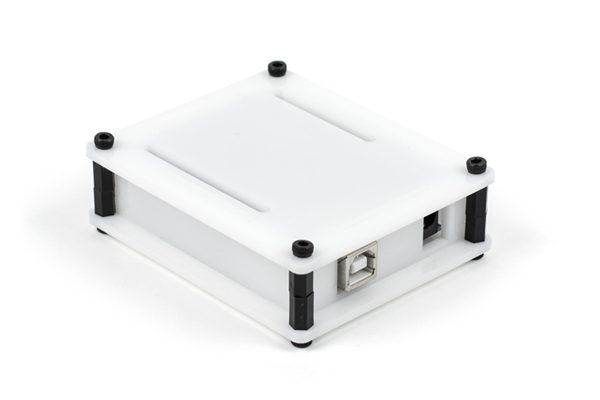
For many of their Raspberry Pi products, they use Ponoko’s laser cutting service as a “quick, cost-effective means of creating custom project enclosures without investing in our own laser cutter.”
Innovative concept brings emerging technologies together
No stranger to tinkering with Augmented Reality, Patrik Johansson has gone one step further by combining 3D printed puzzle tiles to create an AR jigsaw that is really turning heads.
The markers were produced in Photoshop, with 3D printing achieved via SketchUp. Making the most of SketchUp’s versatility, the Augmented Reality model uses AR-media’s Plugin to bring the jigsaw to life.
Marblevator: a fully configurable marble run you can print yourself
This Thingiverse project from dedicated enthusiast gzumwalt has what it takes to give a 21st Century twist to an age-old favourite toy.
The Marblevator (marble elevator) is at the heart of it all, endlessly stepping little balls up until they meet with the whims of gravity. Additional track segments easily snap together and clever height-adjustable tressels combine to allow you to build with complete freedom, creating one of those mesmerising toys that you could happily lose yourself in for hours on end.
Click through to see more detail on the tressel mechanism, as well as a collection of video clips of those balls going round and round and round.
It was love — of wood — that lead designer Valerie Thai to laser cutting.
“I have always loved working with wood as a medium. In the past I did a lot of woodburning (pyrography) as a hobby and craft,” she says.
When Valerie started seeing laser cut wood designs on various blogs, she decided to research the method a little more. She then came across Ponoko in the Etsy forums. “It was really exciting to know that there was a way I could work directly with a user-friendly laser cutting company,” she tells me.